2025 was quite eventful. We saw neural networks learn to joke (sometimes creepily), brands return to “old-school” videos shot on flip phones, experiment with formats, and integrate technology, emotion, and interactivity. This year brought exciting campaigns that are changing the approach to generate effective creatives.
We don’t want to bore you with dry analytics. Instead, AdKeys team have collected the most interesting, viral, and daring creatives of the past year to inspire you in the coming 2026.
Top 5 Video Ads of 2025: Why Did They Work?
This year, the market split into several camps: some played on tears and nostalgia, while others went completely absurd or tested neural networks. But most of them share one main trend: videos that tell a story rather than just showing a product. These formats don’t work for direct sales, but rather for building an emotional connection with the audience. Here are the five that did it best.
1. Coca-Cola and "Fully AI Christmas"
Coca-Cola took a risk and released a reimagining of its iconic “Holidays Are Coming” ad, generated entirely by neural networks (Sora/Runway).
Why it’s trending: it sparked a storm of hate and praise at the same time. The video proved that AI can already create “cinematic” images, but many felt it lacked “soul.” The hype was incredible.
2. LEGO – Is It Play You’re Looking For?
LEGO took Lionel Richie’s timeless classic “Hello” and ingeniously rewrote the lyrics: now it’s “Is it play you’re looking for?”
Why it’s at the top: this is storytelling at its best. Instead of a dry demonstration of the sets, we are shown a story about how play brings generations together. The video tugs at parents’ heartstrings and engages children. This is emotional marketing in its purest form — you’re not buying plastic, you’re buying the warmth of a family evening.
3. Nike – So Win (Super Bowl 2025)
Once again, Nike isn’t selling sneakers, but rather the will to win. A powerful Super Bowl manifesto focused on star athletes and overcoming oneself.
Why it’s at the top: the brand is true to its DNA. No technical specifications about the soles — just pure adrenaline, dynamic editing, and inspiration. People repost this kind of content because it makes them feel better and stronger. This work is not about clicks, but about eternal love for the brand.
4. Intermarché – Unloved (The Lonely Wolf)
The French team at Intermarché has once again demonstrated that a supermarket advertisement can resemble a Pixar short film. This is a touching animation about a wolf searching for his place in the world.
Why it’s in the top: the video completely bypasses the brain’s defense mechanisms that say, “They’re trying to sell me something.” It’s a story about empathy and acceptance. When a brand evokes such strong emotions (even tears), the viewer unconsciously transfers that warmth to the store itself. This is the highest level of native advertising of values.
5. Pringles – “Call of the Mustaches”
Absurdity of the 80th level with James Harden and Nick Offerman. The characters’ mustaches literally come to life and turn into an epic army for the sake of a can of chips.
Why it’s trending: while other brands tried to be serious, Pringles bet on humor and self-irony. The surreal plot is perfect for Generation Z and instantly turns into memes. This is an example of how celebrity cameos and a strange script create a viral effect.
AI Creatives 2025: Masterpieces and Failures
In 2025, generative AI ceased to be just a toy and became a working tool for creating advertising content — from personalized visuals to full-fledged videos. Brands experimented boldly, but not all attempts were successful: some campaigns went viral, while others were heavily criticized for “AI slop” (cheap, “plastic” content). Here are five striking examples: three hits and two failures that we can learn from.
Masterpieces: When AI Worked Perfectly
Popeyes — "(w)Rap Battle"
Popeyes used AI to generate a humorous rap battle between its chicken rolls and competitors (a reference to McDonald’s). The video, featuring absurd lyrics and animation, garnered over 50 million views, went viral on TikTok, and increased sales by 25%.
Why it’s a masterpiece: it was funny, absurd, and perfectly suited to TikTok culture. The neural network produced lyrics and animation that people didn’t perceive as “advertising” but as entertaining content.
Kalshi – "World Gone Mad"
A small fintech platform made a 30-second commercial that looked like a Hollywood blockbuster but cost pennies. Surreal images of a “world gone mad” were shown during the NBA finals.
Why it’s a masterpiece: the image quality was shocking. Kalshi proved that with the help of AI, a small brand can visually compete with giants without inflating its production budget.
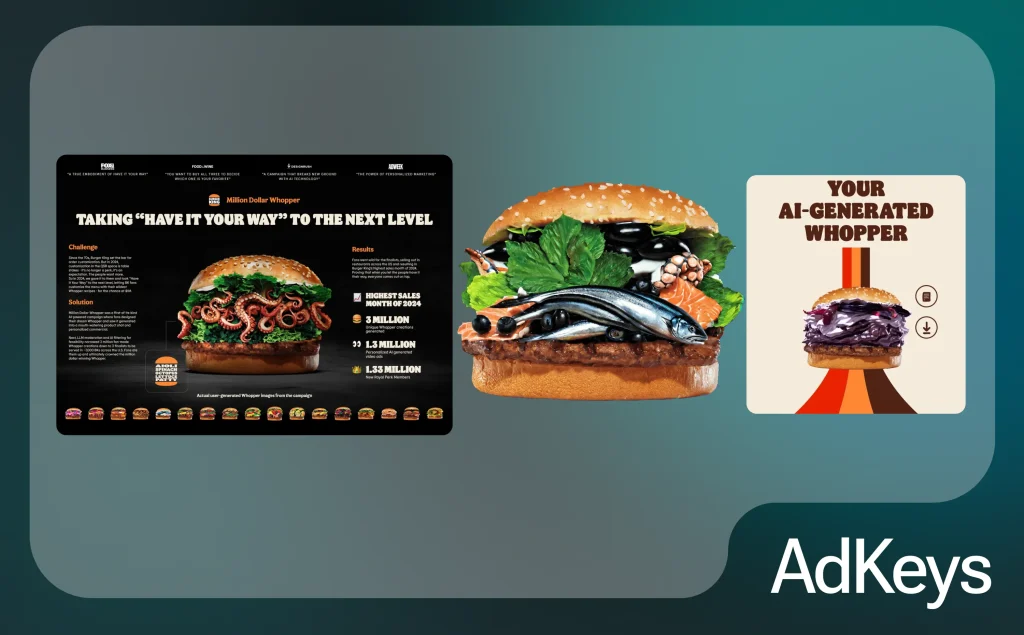
Burger King – "Million Dollar Whopper"
Users were invited to create their dream burger using a neural network (with a purple bun or caramel, for example). The best creator received $1 million.
Why it’s a masterpiece: gamification. People love to play with construction sets. AI turned product creation into fan entertainment, and social networks were filled with thousands of generated (and very strange) woppers.
Failures: When Something Went Wrong
McDonald's Netherlands — AI Christmas Ad
The Christmas ad, entirely drawn by a neural network, showed the chaos of the holiday season and “salvation” at McDonald’s.
Why it failed: the visuals turned out strange and “dead.” Viewers did not feel that McDonald’s warmth. The video was called “AI slop,” accusing the brand of laziness, cynicism, and killing the Christmas spirit.
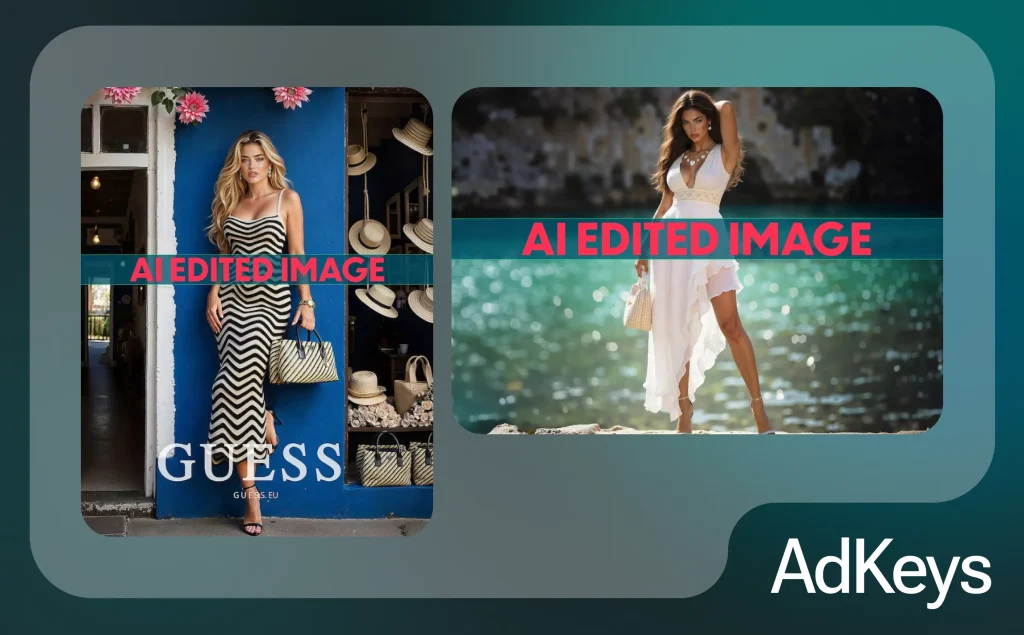
Guess – AI Models in Vogue (August 2025)
The clothing brand Guess placed an advertisement in the August issue of American Vogue, where fully AI-generated digital avatars were used instead of real models. The visuals looked hyper-stylized, but caused widespread rejection: the brand was accused of losing authenticity, creating an “uncanny valley” effect, and replacing real models (which intensified the debate about job losses for people in the industry). TikTok and social media exploded with criticism, and Vogue also came under fire for publishing the campaign. It became one of the most talked-about campaigns on the “worst ads of 2025” lists.
Why it failed: loss of emotional connection with the audience, accusations of ignoring ethical issues surrounding AI and attempting to cash in on a cheap hype, forgetting the soul of the fashion industry.
AI enhances creativity when it adds personalization and humor (as in Popeyes or Kalshi), but fails when it attempts to replace empathy and genuine emotions. The future lies in a hybrid approach: humans conceive and control, while AI designs and scales.
Alyona Borovko, Marketing Manager
The Best Interactive and Tech-Driven Creatives of 2025
In 2025, we stopped being mere spectators. Brands realized that to overcome banner blindness, they needed to let users play, build, or become co-creators.
Here are three campaigns that set the technological standard for the year and showed how to work with attention:
Apple: Draw on your iPad, light up London (UGC + DOOH)
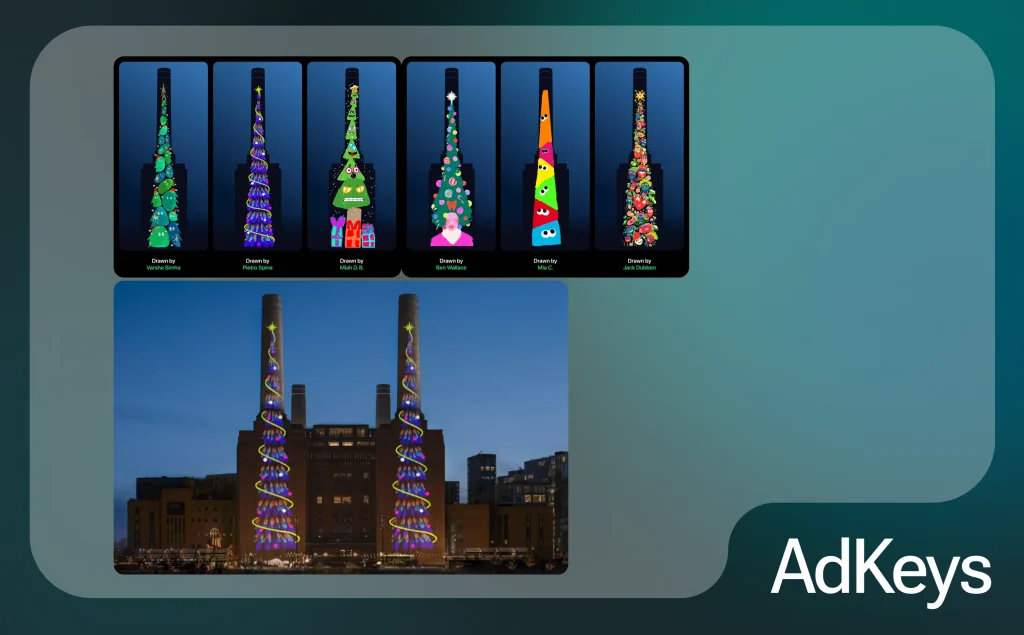
At Christmas, Apple turned the facade of its London headquarters (Battersea Power Station) into a giant canvas. Users drew their own versions of Christmas trees on their iPads and sent them via an app. The best works were projected onto the building in real time.
Why it’s wow: it’s the perfect mix of digital and outdoor advertising. Apple turned a static billboard into a collective art project. People came to the building to see their drawings, filmed them on TikTok, and took pride in being co-authors. The result was millions of touches and powerful loyalty.
Decathlon and Apple Vision Pro: Camping in your living room
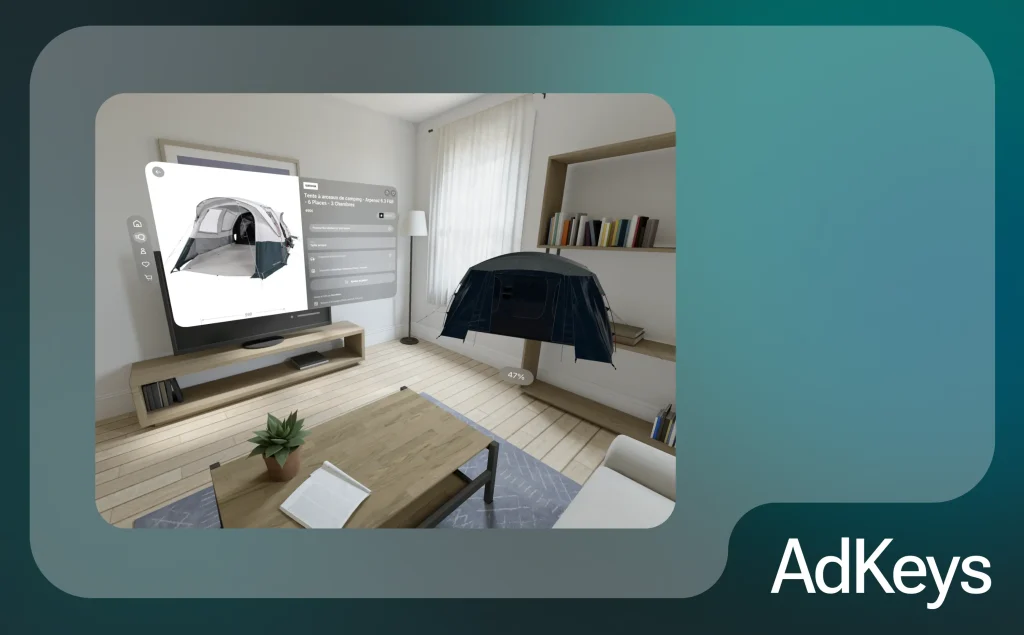
Decathlon became one of the first retailers to truly master spatial computing (launched in February 2024, but still relevant thanks to major updates in 2025). In their visionOS app, you can pull a 3D model of a Quechua tent into your room in real size, literally “enter” it, examine the seams, or spin a new e-bike around from all sides. In 2025, they added the “Build Your Camp” feature—building an entire camp in AR.
Why it’s wow: it eliminates the main objection to online shopping: “What if it doesn’t fit?”
- Fewer returns: shoppers can see the actual dimensions of the product and “try it on” in their own space.
- Engagement: the average session time has increased to 10-15 minutes (which is huge for retail!). It’s a shift from boring scrolling to an immersive experience.
Verizon: Streets Speak (AR Murals in Miami)
Verizon teamed up with local artists in Miami to create a series of interactive murals. Passersby scanned the street art via Snapchat, and the drawings came to life in augmented reality, triggering animations and music.
Why it’s wow: brilliant use of foot traffic. To see the magic, you had to physically come to the location.
The result: 657,000+ lens launches and viral shares on social media. The brand became part of the city’s culture, not just “another telecom operator.”
In all three cases, the technology did not exist in a vacuum. It connected the online world (app, AR) with the real world (building, buyer's room, city street). This phygital (physical + digital) approach is gradually becoming the standard.
Alyona Borovko, Marketing Manager
What to Do With All This? A Short Checklist:
- Don’t be afraid to be “weird”: the Pringles and Popeyes cases show that absurdity and humor are more memorable than polished product presentations.
- AI is your assistant, not your replacement: use neural networks for speed, scale, and crazy visuals, but always leave “human control” in place. Without genuine emotion, you’ll end up with that “AI slop” that your audience can spot in a second.
- Blur the lines (Phygital): if you have the opportunity to connect your mobile app to the real world (through AR, interactive screens, or UGC), do it. The experience of “involvement” sells better than any banner.
- Storytelling > Sales: tell a story (like LEGO or Intermarché). First, make the user feel something, and then the purchase will become a natural continuation of that emotion.
Looking at Trends is Fun. Implementing Them is Difficult.
2025 has proven once and for all that standard advertising approaches no longer work. Users have learned to masterfully ignore anything that reeks of “just advertising.” The AdKeys team doesn’t just follow these trends, we turn them into working tools for your business. We:
- Know how to create UGC that doesn’t look like advertising.
- Know how to use AI in a way that isn’t embarrassing.
- Test hundreds of hypotheses while you drink your coffee.
Are you ready to take the market by storm in the new year? Write to us and let’s discuss your strategy!