In the world of mobile advertising, especially for games, choosing a platform is like choosing a weapon in the battle for users. Unity Ads has long been known not only as a monetization tool, but also as a powerful source of paying users.
However, over the past two years, Unity has undergone several reputational and technical changes, from a public scandal surrounding its payment policy to large-scale updates to its advertising platform. Today, the platform promises deep optimization for LTV and ROAS, AI features, and a huge inventory in top mobile games.
What did Unity Ads look like in 2025? The AdKeys team has conducted an honest analysis of the platform’s capabilities, tools, pros, and cons to determine when this network should be prioritized and when it is better to look at Liftoff or Moloco.
What is Unity Ads?
Unity Ads is an advertising platform that is part of the Unity ecosystem, specializing in monetization and user acquisition in mobile games and applications created using the Unity Engine.
Unlike universal DSP platforms, Unity Ads is primarily tailored for the gaming vertical, which is its main strength (and at the same time its limitation).
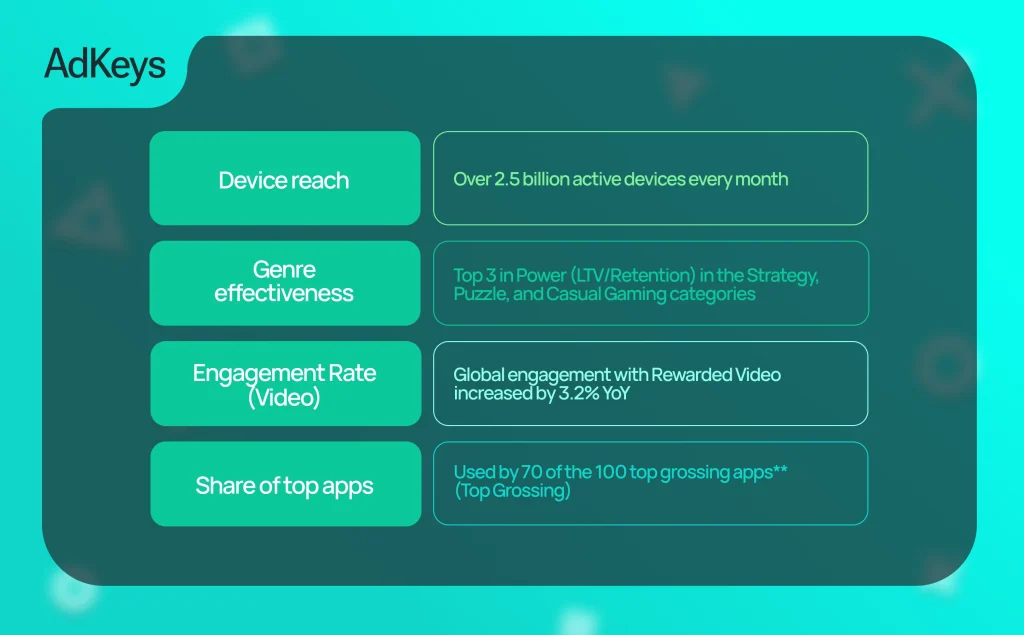
Today, Unity Ads is:
- One of the largest sources of in-app traffic.
- A platform that consistently ranks high in the AppsFlyer Performance Index for retention and LTV metrics, especially in the Midcore, Casual, and Strategy Gaming categories.
- A tool offering a full range of modern advertising formats: Rewarded Video, Interstitial, Playable Ads, and banners.
Its main feature is deep integration with millions of apps developed on the Unity engine, providing access to a huge, solvent, and engaged gaming audience.
What Has Changed in Recent Years:
- Transition to 100% in-app bidding — Unity is officially moving towards full support and optimization of in-app bidding, which increases competition for impressions and theoretically improves eCPM for publishers and the quality of purchases for advertisers when configured correctly.
- AI and new optimization tools — Unity is integrating AI features into its advertising platform (including Vector/AI optimization products), which is already reflected in its quarterly results.
- Focus on the quality of the advertising experience — Unity is releasing ad quality control and research tools that show that a poor ad experience is detrimental to retention. This is important: low-quality creatives and irrelevant targeting are more likely to lead to churn.
- Privacy and legal updates — Unity is updating its DPA and data processing practices, which affects attribution and the availability of signals for targeting (important to consider with SKAdNetwork/ATT).
Key Features of Unity Ads and What Makes it a Leader in Gaming?
1. Vector AI targeting for traffic quality
Unity uses its own Vector AI engine, which is the platform’s main competitive advantage.
- Real-time analysis: vector analyzes huge amounts of data on user behavior (what games they download, how they interact with ads, how quickly they make IAPs) in real time.
- Focus on High-Value: this allows the system to find and target “High-Value” users who are most likely to achieve the target LTV and make in-game purchases or actively view ads.
2. Deep ROAS/LTV optimization
Unity Ads can work with advanced goals that go beyond simple CPI (Cost Per Install).
- ROAS/LTV optimization: you can set up your campaign so that the system finds users who are most likely to make a purchase or generate revenue from in-app advertising. ROAS campaigns with auto-bidding involve automation, where you can set a goal (e.g., 1.5x ROAS) and the system adjusts the bids itself.
- Event optimization: the platform allows you to optimize for key events in the app that are important for long-term retention (completing a tutorial, reaching a level, subscribing).
3. Premium in-app inventory (Gaming focus)
Unity Ads primarily purchases traffic in apps created on Unity Engine, but is also connected to many other large networks.
This provides:
- High-quality audience: users who already play games and interact with in-app advertising are more likely to engage with your product.
- Scale in gaming: Unity Ads consistently ranks among the top three in terms of effectiveness across various game genres, as confirmed by reports such as the AppsFlyer Performance Index.
4. Rewarded Video as a retention tool
The Rewarded Video (RV) advertising format is one of Unity Ads’ strengths. Using RV increases LTV, as users perceive the ads as part of the gaming experience. Therefore, it not only generates revenue but also, according to statistics, increases session time and retention. It works well in combination with Playable Ads, a high-converting format that allows users to play a mini-demo before downloading. Unity Ads is actively working with this format.
5. Unified ecosystem and bidding support (SSP/DSP)
The platform offers a unified SDK that covers both monetization (supply-side) and user acquisition (demand-side) needs.
- A single SDK for everything: developers can use the same Unity tools for monetization and traffic purchasing, which simplifies integration and analysis.
- Mediation and bidding support: Unity Ads actively participates in real-time bidding through popular mediation platforms (AppLovin MAX, IronSource LevelPlay, etc.). This allows advertisers to receive the highest quality inventory on par with other major DSPs.
6. Tools for Creative Testing
Unity Ads provides a mechanism for testing multiple creative packs with equal exposure. This allows you to accurately determine which visual, message, or approach works best for a specific GEO or audience, and quickly reallocate your budget in favor of the most effective combination.
Who Should Take a Closer Look at Unity Ads?
Unity Ads is ideal for those who:
- Work in the gaming vertical. It is a must-have for all game categories: from hyper-casual to strategy and RPG. This is where the platform shows maximum efficiency and traffic quality.
- Are looking for LTV-oriented traffic. Unity Ads offers campaigns optimized for events that generate revenue, not just installs (ROAS/LTV optimization).
- Use Rewarded Video. If your monetization is based on watching ads for in-game bonuses, Unity Ads is the most logical and effective source.
- Plans large-scale acquisition. Unity Ads is a large ad network that requires significant budgets to train algorithms, but in return is capable of consistently processing large spend and scaling UA campaigns.
- Needs fast creative testing. The platform has built-in mechanics for evaluating the effectiveness of ad packs.
Cons of Unity Ads: What to Consider Before Launching

Like any platform, Unity Ads has its own nuances that require special attention.
1. Strict requirements for LTV/ROAS campaigns
To launch retention or ROAS optimization, it is not enough to simply integrate MMP. You will also need:
- Accumulated data volume: to activate ROAS campaigns, a minimum threshold of paying users is required (for example, 10+ paying users in 30 days). Without this, the campaign can only be optimized for earlier events (e.g., install or registration).
- Training time: Unity Ads algorithms need time (and budget) to find patterns of behavior among high-quality users.
2. High competition and CPM volatility
The game development market is oversaturated, and Unity Ads, as a key player in this market, suffers from high competition.
- CPM growth: due to aggressive buying by top studios, the cost per thousand impressions (CPM) is steadily increasing (estimated at 15-20% per year in key GEOs).
- Low ROAS with weak creatives: if creatives are not engaging or if a campaign is poorly optimized, ROAS can quickly fall below 1X. This is especially noticeable in emerging markets (India, Brazil), where traffic is cheaper but conversion is more unstable.
3. Scaling risks
Scaling on Unity Ads requires constant monitoring and involves certain risks that are characteristic of the entire in-app market. Namely, a decrease in effectiveness as spending increases. Often, at the start (with small budgets), ROAS is high, but with a sharp increase in spending (from $10k per month), algorithms “learn” more slowly, and traffic quality may decline.
4. Limited targeting and influence of ATT
Basic targeting is quite limited (geo, OS, device version). For more accurate targeting of specific app categories (for example, to advertise only in Match-3 games), you need to work with representatives—you have to contact platform managers to compile an Allow List (a list of permitted apps/categories) to control the quality and relevance of traffic.
It is also worth remembering the limitations of accuracy due to privacy (iOS/Android). iOS ATT policies and general trends towards increased privacy on Android (Privacy Sandbox) limit the Vector AI engine’s access to data. This complicates predictive analytics and reduces the accuracy of finding high-value users, which requires more time for training.
5. Weakness outside the gaming vertical
Although Unity Ads is formally open to all applications, its algorithms and inventory are tailored as much as possible to the gaming audience. For e-commerce, Fintech, or Dating, its effectiveness may be lower compared to Moloco, Liftoff, or Meta/Google. Inventory and data for optimization for these non-gaming verticals may be less extensive and of lower quality.
6. Moderation complexity for "gray" verticals
Although Unity Ads is more loyal to game mechanics than Google or Meta, its advertising policy is quite strict. Complex verticals, such as gambling or betting, require special care with creatives in order to pass moderation and not be blocked.
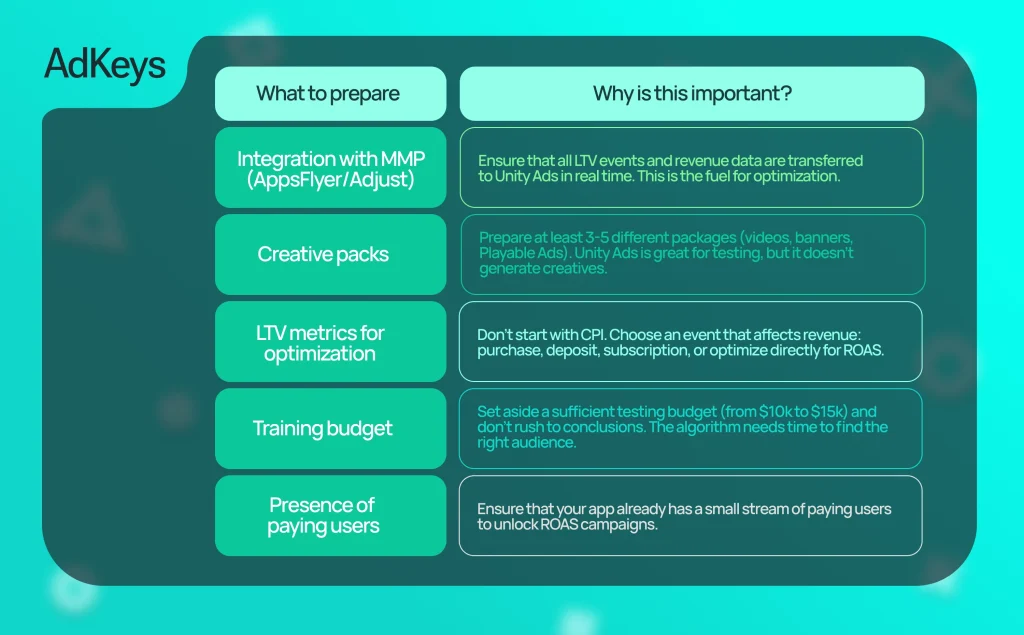
Checklist Before Launching on Unity Ads
If you’ve decided that Unity Ads is right for you, follow these steps to get your campaign started with maximum effectiveness:
Why Do Budget "Leaks" Occur?
Unity Ads is a powerful but complex tool. Even with the Vector AI engine, mistakes on the advertiser’s side can quickly lead to inefficient budget spending.
Below are some real-world reasons that are common in the industry, and Unity is no exception:
- Poor creative strategy. Unadapted, low-quality, or repetitive creatives quickly degrade (ad fatigue sets in).
Result: A drop in CTR and conversions, leading to an increase in CPI/CPA and a decrease in ROAS. Unity Ads, as a platform with high traffic volumes, requires constant testing and updating of creative packs. - Incorrect attribution model & privacy. Limited signals due to privacy policies (iOS ATT, SKAdNetwork, Android Privacy Sandbox) require a different optimization strategy.
Result: If campaigns continue to operate under the old rules, they “spend” the budget without obtaining sufficient data on user quality, which leads to slow ROAS growth or no growth at all. - Incorrect optimization goals. Optimization for impressions (CPM) or clicks (CPC) instead of LTV-oriented metrics (ROAS, in-app purchase, subscription).
Result: The platform will actively drive traffic and achieve installation goals, but attract low-quality users. - Insufficient testing and data processing. Lack of ongoing A/B testing of creatives and goals, as well as poor use of LTV models.
Result: No understanding of which creative + audience combination generates revenue, leading to incorrect conclusions about traffic quality and suboptimal budget allocation. - Seasonality and competition in in-app bidding. eCPM and flow (traffic quality) vary depending on the season (especially in Q4) and on the activity of competitors in the in-app bidding auction.
Result: Without flexible and prompt adjustment of bids and budgets, you may start losing the auction for quality traffic or, conversely, overpay for it, leading to a sudden drop in ROAS.
When Should You Choose Unity Ads, and When Should You Not?
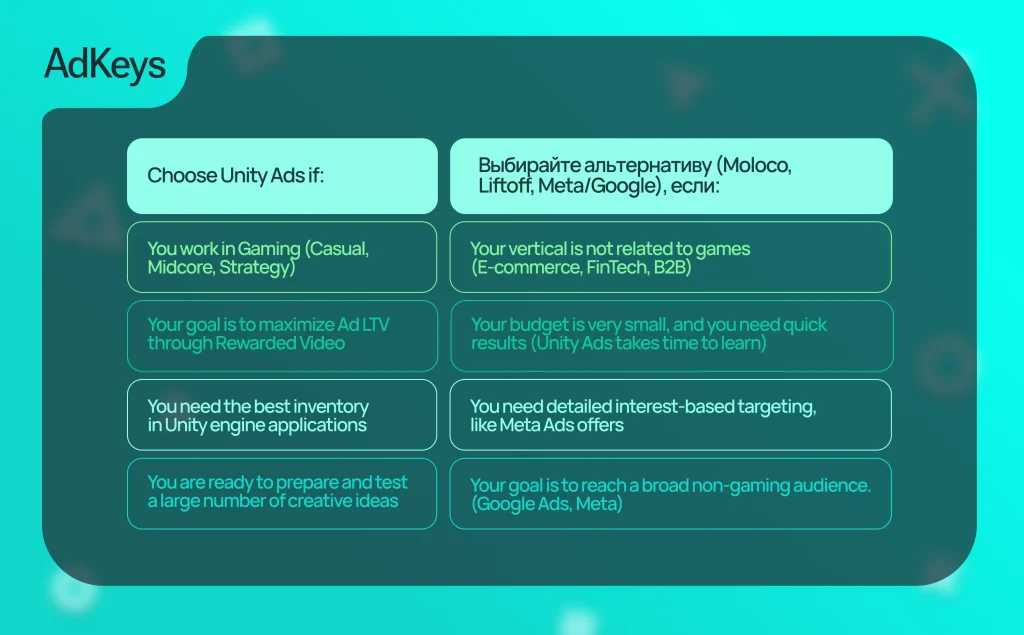
Conclusion: Drain or Stable ROAS?
Unity Ads in 2025 is a tool that can deliver stable ROAS, but not by default. Choose it if you work with mobile games and are ready to play by the rules of ROAS optimization. The platform has evolved (in-app bidding, AI optimization, quality tools) and demonstrates growth in Ad Network profitability, but the success of your campaigns will depend on:
- the quality of creatives and testing;
- correct goal setting and analytics integration;
- understanding of current privacy restrictions and SKAN;
- ability to manage dynamic bids and pause rules.
In short: it’s not a scam, but it’s not a magic pill either—the platform provides tools for ROAS growth, but without competent work on the part of the advertiser, the money will go nowhere.
If you want to test Unity Ads and launch campaigns with guaranteed expert support and maximum efficiency, the AdKeys team is ready to help. We have experience working with the largest DSP networks and know how to get the most out of your budget.
Submit your request and we will help turn your product into a market leader!