The Death of the Classic Banner and the Birth of Interactivity
Smartphone users see up to 10,000 advertising messages per day, and the brain has learned to automatically filter out most of them—this is how banner blindness is born. It is especially noticeable in the mobile environment: users scroll through their feed without noticing banners and pop-ups, even if they are visually striking.
The CTR of banners on mobile devices does not exceed 0.05-0.46%, with up to 50% of clicks being accidental taps rather than deliberate actions. Tighter data privacy regulations (Apple’s ATT and GDPR) exacerbate the situation by limiting targeting and making banners less relevant.
AdKeys team monitor trends and note that formats that engage, adapt to the user, integrate into content, and turn passive viewers into active participants are coming to the forefront. This not only circumvents banner blindness, but also focuses on long-term customer value—LTV (Lifetime Value). Instead of useless app installations that often end in rapid churn, these formats attract a high-quality audience, increase retention, and boost monetization.
Format #1: Rewarded Experience
Essence: Fair exchange of values
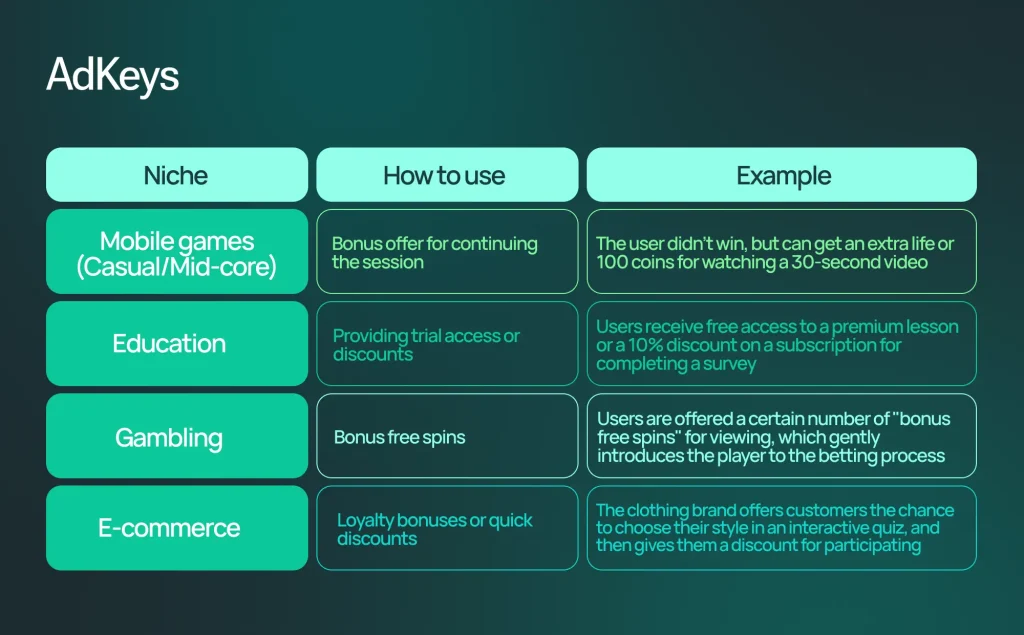
Regular full-screen videos (interstitials) often cause irritation because they interrupt interaction with the app. Rewarded Experience works differently. It is any advertisement or action that the user chooses to perform in order to receive a bonus: an extra life, game currency, premium access for an hour, or a discount.
This can be: Rewarded Interstitial Video—a regular full-screen video, Rewarded Playable Ad—a mini-game (app preview), Rewarded Survey—a short survey, Rewarded Offer Wall—completing a specific task (for example, “download app X” or “reach level 5 in game Y”) for a large reward.
Why it works:
The main feature of this format is user-driven engagement, which increases loyalty and ensures a high viewability rate (over 90%). According to statistics, players who actively interact with the reward mechanics are already more engaged in the process and demonstrate higher LTV.
Case study: Avid.ly (Mobile games, China)
Problem: Avid.ly, a developer of more than 50 casual games, faced a dilemma: is it possible to implement rewarded ads without losing revenue from a small but solvent segment of users who make in-app purchases (IAP).
Result: after adding a reward mechanic to one of their games, the developers saw a synergistic effect:
- Users began spending 20% more time in the game.
- The frequency of in-game purchases increased by 18%.
- The app’s total revenue grew by 40%.
Conclusion: Rewarded Experience does not replace IAP, but rather stimulates monetization. By providing bonuses, advertising increases engagement, prolongs sessions, and shows the value of digital goods to non-paying audiences, encouraging them to make their first purchase.
Format #2: Immersive Ads (AR/VR and 3D creatives)
Essence: Creating sensations
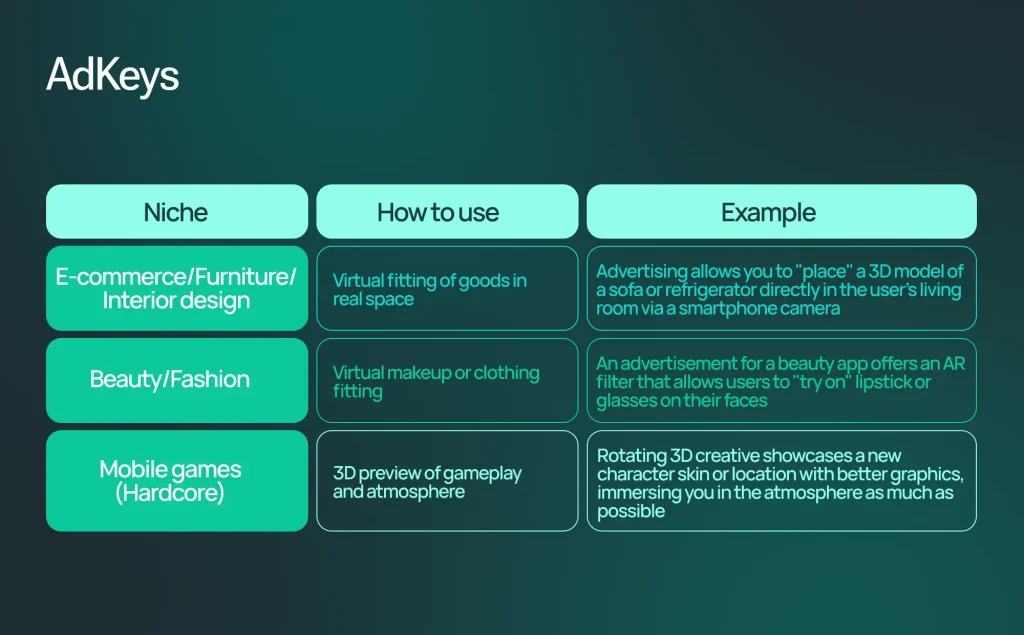
Immersion is achieved through augmented reality (AR) and realistic 3D creatives, allowing users to interact with the product before it is installed.
Effect: High memorability and conversion rates
AR formats ensure high levels of engagement and brand memorability, as users participate in the ad rather than simply viewing it. This is the ideal format for demonstrating value and focusing on high-value users.
According to a report by Deloitte Digital and Snap Inc., AR experiences increase the likelihood of consumers considering a brand as a potential purchase by 41%. And 40% of consumers are willing to pay more for a product if they can experience it in augmented reality.
Analysts predict that augmented reality advertising revenue will reach $6.72 billion by 2027, underscoring the growing recognition of this channel as an important element of user acquisition strategy.
Case study: L’Oréal (Virtual Try-On)
Problem: How to increase consumer confidence in buying cosmetics (especially makeup) online, where there is no opportunity to try the product, while minimizing returns?
Solution: L’Oréal integrated Virtual Try-On (VTO) technology into its advertising campaigns and mobile apps, allowing users to “try on” different shades of lipstick, eye shadow, and other products using AR.
Result:
- Increased conversion: The use of VTO features led to a 19-21% increase in conversion rates compared to traditional ads.
- Revenue: In some categories, such as hair dye sales, the AR experience led to a 43% increase in revenue by boosting consumer confidence in the final result.
- Reduced returns: VTO technology reduces the risk of color selection errors, which is critical for customers and directly saves retailers money on logistics.
Conclusion: AR advertising transforms e-commerce from passive viewing to active experimentation and helps solve the problem of buyer uncertainty.
Format #3: Dynamic Creative Optimization (DCO) and AI-generated creatives
Essence: Personalization at the nanosecond level
DCO is the invisible hero of modern performance marketing: not just a format, but a technology that makes any format (from video to Playable Ads) as effective as possible.
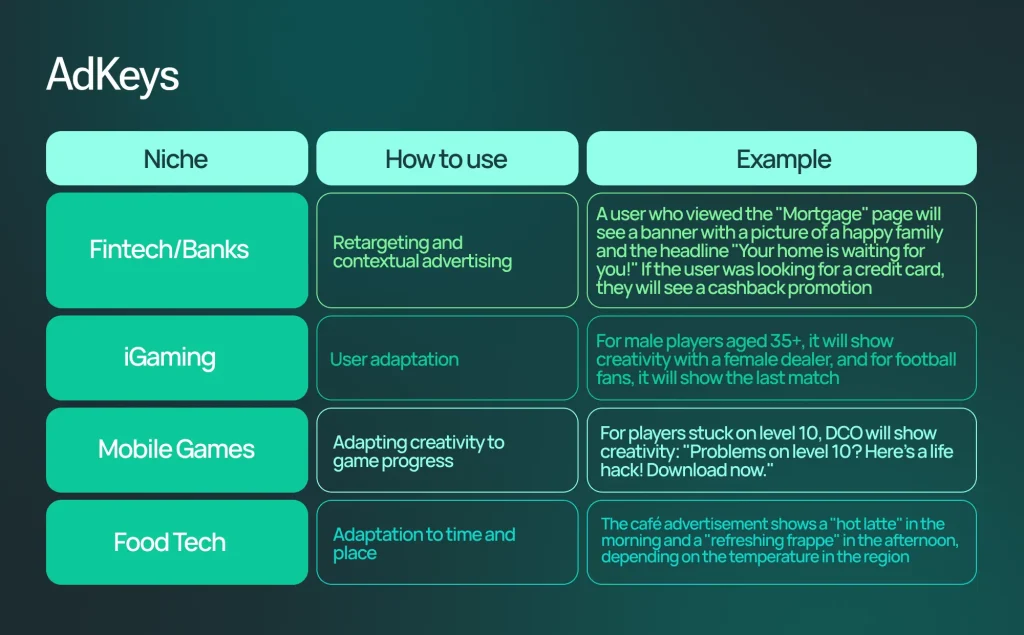
Artificial intelligence analyzes user data in real time: their recent searches, demographics, interests, and sometimes even the time of day or weather. It then automatically assembles advertising creatives from available elements, allowing thousands of unique creatives to be launched simultaneously instead of just 10, and eliminating the need for manual A/B testing of different combinations.
According to leading AdTech platforms, the use of DCO can provide a 20-50% increase in CTR and CR compared to static campaigns, as the ad is always as relevant as possible to the user’s interests. In addition, personalization implemented through DCO directly correlates with long-term loyalty and purchase frequency, which leads to an increase in LTV.
Case study: Hyundai (Automotive industry)
Problem: Hyundai needed to launch an advertising campaign for several car models in multiple regions, tailoring the message to local dealerships, financing terms, and the specific advantages of each model to maximize the effectiveness of media advertising. Creating thousands of static creatives was impossible.
Solution: the campaign was built on the Dynamic Creative Optimization platform, which collected and used triggers in real time to personalize each ad:
- Geolocation: the ad automatically substituted the address and name of the dealership closest to the user.
- Model and Benefits: depending on the user’s demographics and browsing history, DCO displayed the right model (e.g., family crossover or sports sedan) with the corresponding key benefit (e.g., “special credit offer” or “low fuel consumption”).
- Prices/Special Offers: the creative displayed real-time prices and current promotions available only in that specific region.
Result:
- CTR increased by 175%, proving that personalized dynamic creatives are perceived by the audience as much more relevant and compelling.
- ROAS increased by 13%, confirming the direct financial benefit of using DCO to optimize advertising spend.
Format #4: Interactive advertising on Smart TV (CTV Interactive Ads)
Essence: A bridge between the sofa and the mobile phone
Smart TV (Connected TV) has become a powerful tool for reaching an affluent audience. The main problem with traditional TV advertising is that you can’t “click” on it. Interactive CTV advertising solves this problem.
Interactive ads allow you to interact directly from your remote control or smartphone: select a product, view additional content, or follow a QR code.
Interactive CTV advertising provides ultra-high viewability (over 95%) and a level of engagement that is 5-10 times higher than interactive video advertising on mobile and desktop devices.
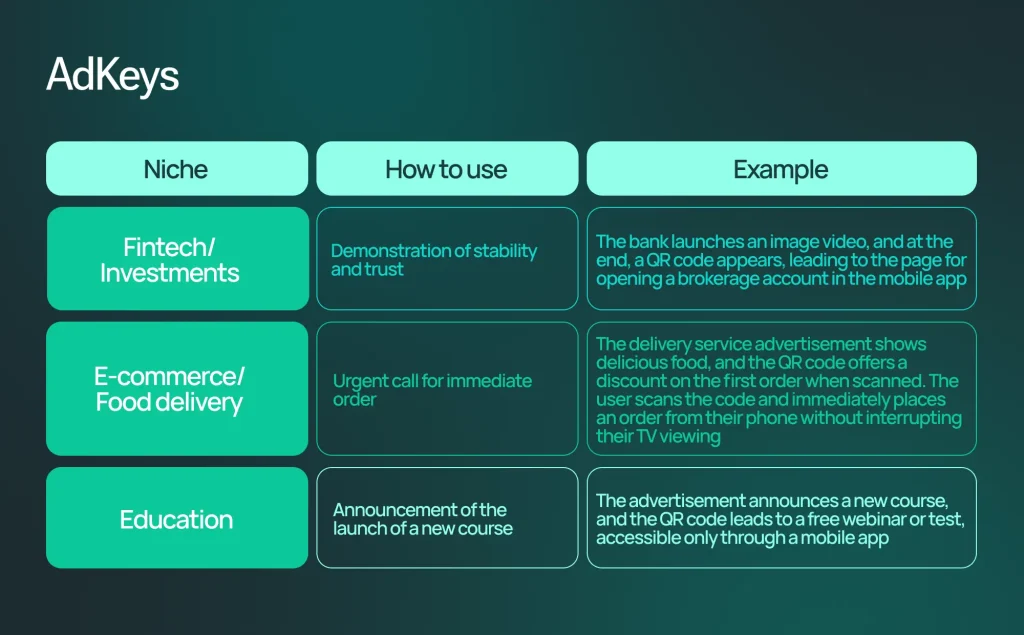
Case Study: Wendy’s and DoorDash
Problem: the Wendy’s restaurant chain wanted to maximize orders through the DoorDash delivery service using large-screen advertising, but needed a measurable, direct conversion channel that would turn ad views into immediate action.
Solution: Wendy’s partnered with Roku (a leading CTV platform) and DoorDash to launch an interactive advertising campaign using Action Ads.
- Format: During the Wendy’s commercial, a call-to-action button appeared on the screen that viewers could press directly with their Roku remote.
- Action: Pressing the button immediately sent a text message (SMS) to the viewer’s phone (linked to their Roku account).
- Conversion: The SMS contained a promo code (e.g., “$5 off orders over $15”) and a direct link to Wendy’s storefront on the DoorDash app.
Result: By eliminating the need to scan a QR code (which can be inconvenient for some users) and providing an instant, personalized incentive (promo code), the campaign achieved:
- 14% increase in ROAS (Return on Ad Spend).
- 46% of orders came from new or returning Wendy’s customers on DoorDash: This highlights the ability of interactive CTV advertising to attract valuable audiences and drive new purchases.
Format #5: In-Game Advertising (Native advertising in the gaming world)
Essence: Advertising that doesn't annoy
In-Game Advertising (IGA) is the seamless integration of a brand into the gaming environment itself, especially in mobile games. Unlike Interstitial, IGA does not interrupt the gameplay, does not cause negativity, and provides a long-lasting but unobtrusive brand display.
Brand advertising appears as a billboard on a virtual bus in a city simulator, on billboards in a racing game, or as a branded skin for a character.
AI selects relevant brands based on the player’s profile. For example, in FIFA or Asphalt, billboards change depending on the region, time of day, and campaign.
The in-game advertising market is growing rapidly: according to conservative estimates, it will reach $11.03 billion in 2025 (CAGR 12%) with the global mobile gaming market growing to over $103 billion in 2025.
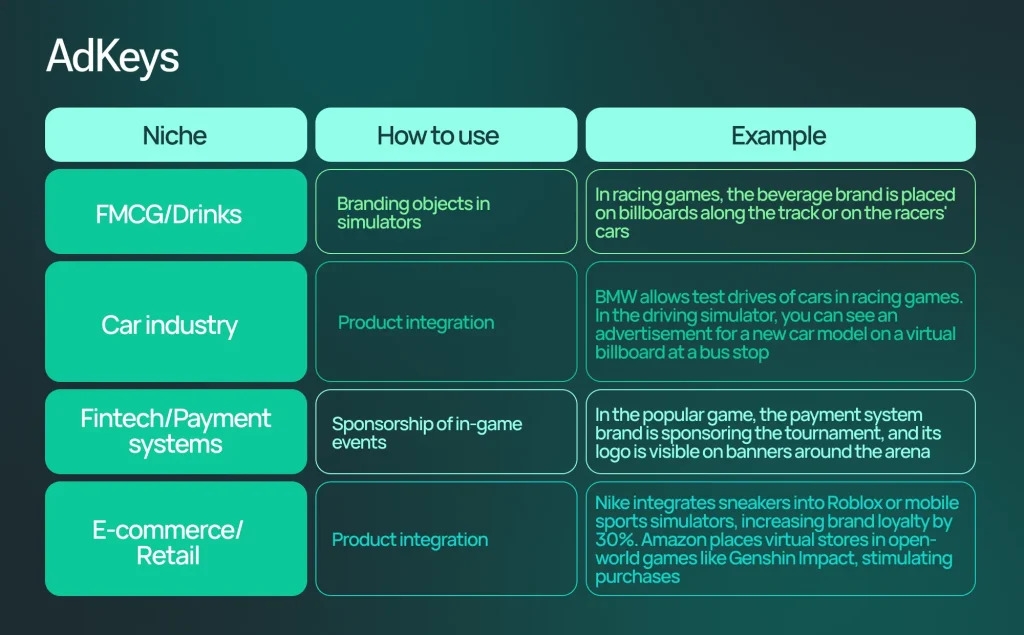
Case study: Burger King and Portuma
Problem: Burger King wanted to interact effectively and unobtrusively with its key target audience—young, tech-savvy people. The key goal was to increase brand metrics and engagement, measured not by clicks (as in CTR), but by views and visibility.
Solution: Burger King partnered with Portuma, a platform specializing in dynamic ad integration into games, to launch an in-game advertising campaign.
Format: native advertising formats were used:
- Dynamic banners (e.g., Burger King posters integrated into the 3D environment of racing or shooter games).
- Rewarded Video and audio ads, which players voluntarily watched to receive in-game bonuses.
Advertising materials were displayed in premium gaming environments where they fit organically into the context (e.g., on virtual billboards or between levels).
Result:
- Viewability: 95%. This figure significantly exceeded the industry average (around 82%), ensuring that almost all ads were actually visible to users on their screens.
- Video Completion Rate (VCR): 93%. This extremely high figure means that the vast majority of users watched Burger King’s video ad to the end, indicating low levels of annoyance and high levels of attention.
- Reach: The campaign generated 945,125 views and 995,897 impressions, ensuring broad and high-quality contact with the target audience.
Format #6: Shoppable Video in short-form content (Reels, Shorts, TikTok)
Essence: Conversion through entertainment in one click
This is not just advertising, it is a hybrid of content and e-commerce. It combines two key trends of 2025: short-form video content (Reels, Shorts, TikTok) as the main channel of engagement and Shoppable Video as a technology for instant conversion. Advertising feels like organic content and contains interactive elements (tags, buttons, links) that allow the user to add a product to their cart or purchase it without leaving the platform.
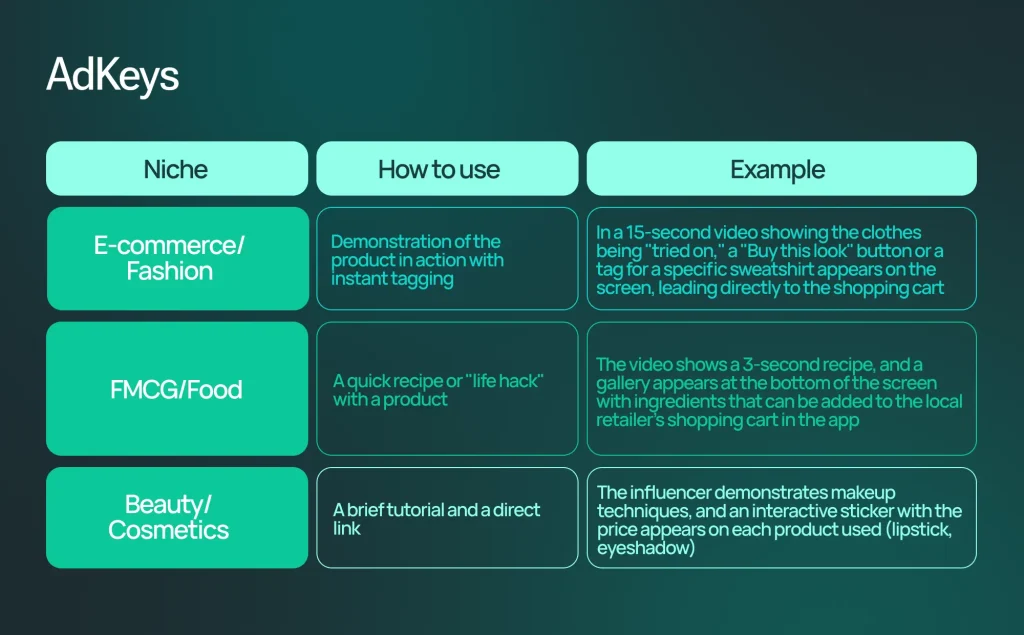
Effect: record-short buyer journey. This format is ideal for impulse buying. It eliminates “friction”—the need to search for a product, remember its name, or scan a QR code.
- Short videos dominate mobile content consumption (more than 50% of time spent on social media).
- Interactive tags eliminate the barrier between interest and action and can increase conversion rates compared to standard video advertising.
- The video is not perceived as advertising—it is useful content.
Case study: Sephora
Problem: how to monetize the huge engagement of the youth audience (Gen Z) on TikTok and bridge the gap between viral content and actual purchases on the Sephora app.
Solution: Sephora integrated native Shoppable Video into its short advertising campaigns on TikTok using the Collection Ads format.
The promotional video showcased various beauty trends and products. Below the video, in a format native to TikTok, a gallery of products featured in the video automatically loaded. Users could scroll through the gallery and click on a product to go directly to the purchase page in the Sephora app.
Result:
- CTR—over 2.5% for individual campaigns.
- The average conversion rate (CR) for purchases showed an increase, proving that the instant transition from viewing to purchasing works.
- A positive Return on Ad Spend (ROAS) was achieved, confirming that investments in this format pay off.
Conclusion: Shoppable Video in short-form content is the future of mobile e-commerce. It transforms TikTok, Reels, and Shorts advertising inventory from a reach tool into a full-fledged, measurable sales channel where entertainment becomes a catalyst for commerce.
Format #7: Geo-targeted advertising in navigation apps (Waze/In-Car Ads)
Essence: native advertising on the move
Although Waze is formally a navigation app, its advertising formats Zero-Speed Takeovers (full-screen banners when the car is completely stopped) and Branded Pins (branded icons on the map) function as clean, non-intrusive mobile IGA. Ads are only shown when they are relevant (the user is near the location) and safe (the car is stationary).
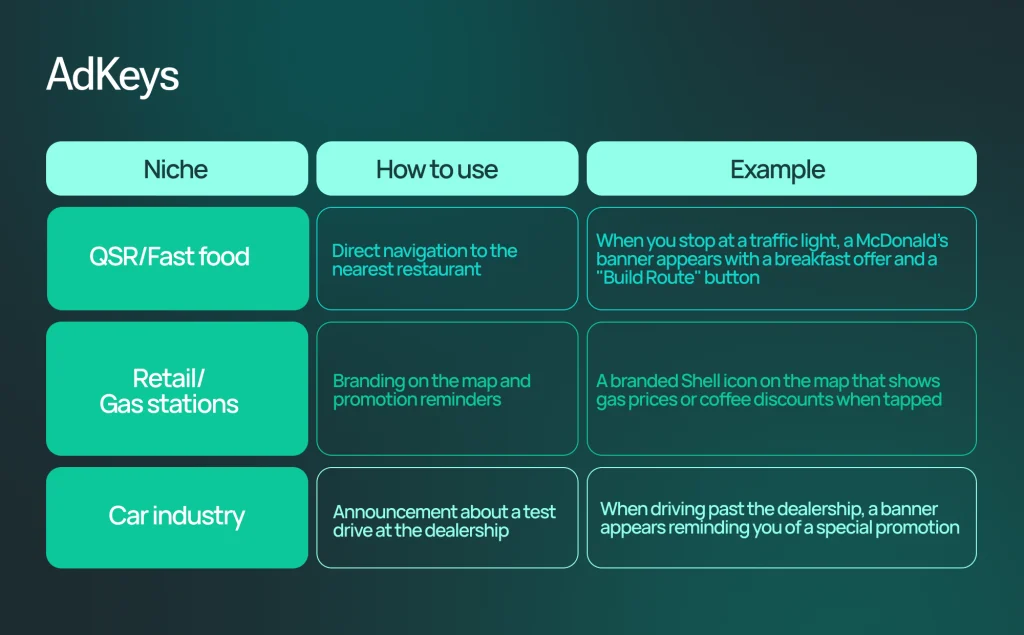
This format is a unique bridge between digital advertising and physical visits. It provides the perfect combination of geotargeting, contextual relevance, and direct conversion to offline sales.
Case: McDonald’s
Problem: effectively use mobile advertising to redirect drivers (potential customers) from the road directly to the nearest McDonald’s restaurants, maximizing impulse purchases.
Solution: McDonald’s in the US (Southern California) launched a campaign that linked real billboards with digital advertising in the Waze app.
Format:
- Geofencing: more than 300 traditional billboards were equipped with geofencing technology.
- Zero-Speed Takeovers (IGA): when a Waze user stopped for a few seconds (e.g., at a traffic light) near such a billboard, a full-screen McDonald’s ad appeared on the screen.
- Unified message: the message in the app duplicated or complemented the message on the physical billboard (e.g., about the return of the McRib).
Result:
- Navigation conversion: Over 8,400 navigation activations were generated, meaning users clicked the “Drive There” button and drove to the restaurant.
- Reach: The campaign reached 1.9 million unique users over 8 weeks.
Conclusion: The case study proved that native, contextually relevant advertising in mobile simulator apps (which, by their very nature, include navigators) can be a powerful tool for mobilizing offline purchases (Mobile-to-Store).
Summary: Focus on quality, not quantity
Banner blindness is not a user problem, but rather an outdated approach by advertisers. The era when you could win simply by buying a million cheap clicks is over. In 2025, the winners will be those who make advertising a natural extension of the user journey.
The formats of 2025 will be interactive, personalized, adaptive, and cross-platform. They will complement the experience rather than interrupt it, and the main goal will be engagement rather than installation. Advertising that encourages participation builds loyalty, trust, and high LTV.
Ready to take it to the next level?
Success in this new world of advertising formats requires not just traffic purchasing, but expertise in creative production and analytics. The AdKeys Digital team is proficient in DCO tools, has experience working with CTV, and creates interactive creatives that not only attract installations, but also ensure high LTV.