The mobile gaming industry continues to dominate the mobile app economy, but promoting games is becoming significantly more challenging. Competition for users is intensifying, the cost of acquisition is rising, and the number of advertising channels is constantly expanding.
According to the AppsFlyer Gaming App Marketing Report, the market is entering a new phase where marketing is scaling faster than user attention is growing, and success depends not only on creative advertising but also on deep data analysis, continuous experimentation, and diversified marketing strategies.
In this article, AdKeys team’ll break down the report’s key findings and offer practical strategies for developers and publishers looking to scale their mobile games in 2026.
The Mobile Gaming Market Continues to Grow—But at a Slower Pace
Mobile games remain the largest segment of the mobile app ecosystem. Global user acquisition spending for gaming apps reached approximately $25 billion in 2025.
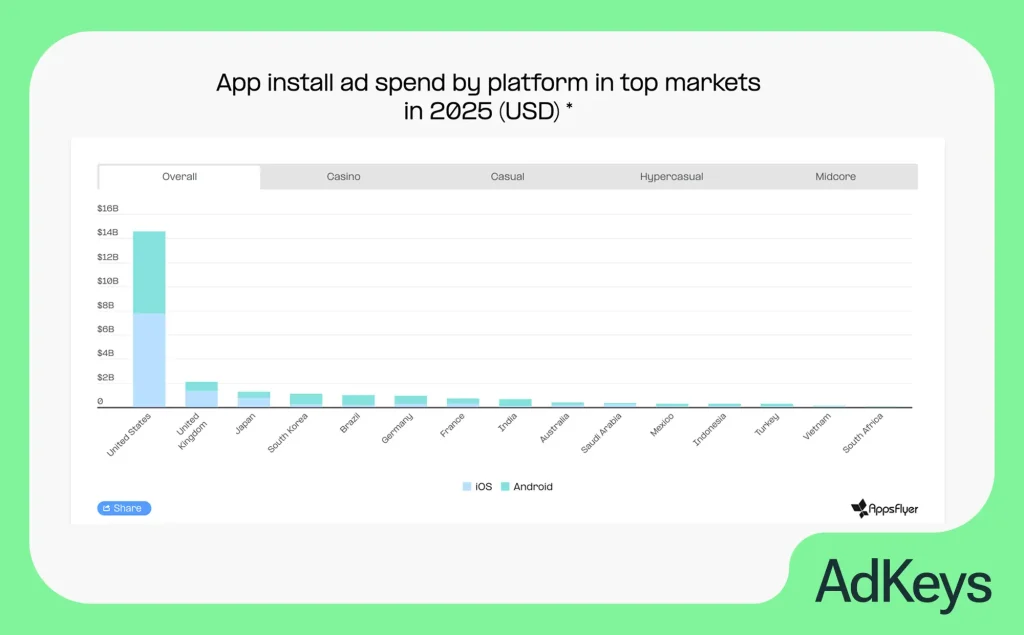
Nevertheless, growth rates have slowed compared to previous years (3.8% YoY). This indicates that the industry is transitioning to a stage of market maturity. Instead of rapid expansion, the market is now characterized by:
- intense competition for installations
- rising user acquisition costs
- a more complex marketing ecosystem
Although budgets continue to grow, marketers must exert increasing effort to achieve the same campaign effectiveness as before.
Competition in Advertising is Growing Faster Than the Audience
Key Metrics
- $25 billion—total global gaming UA budget
- +10%—growth in the share of paid installs
- +20%—growth in the number of ad impressions
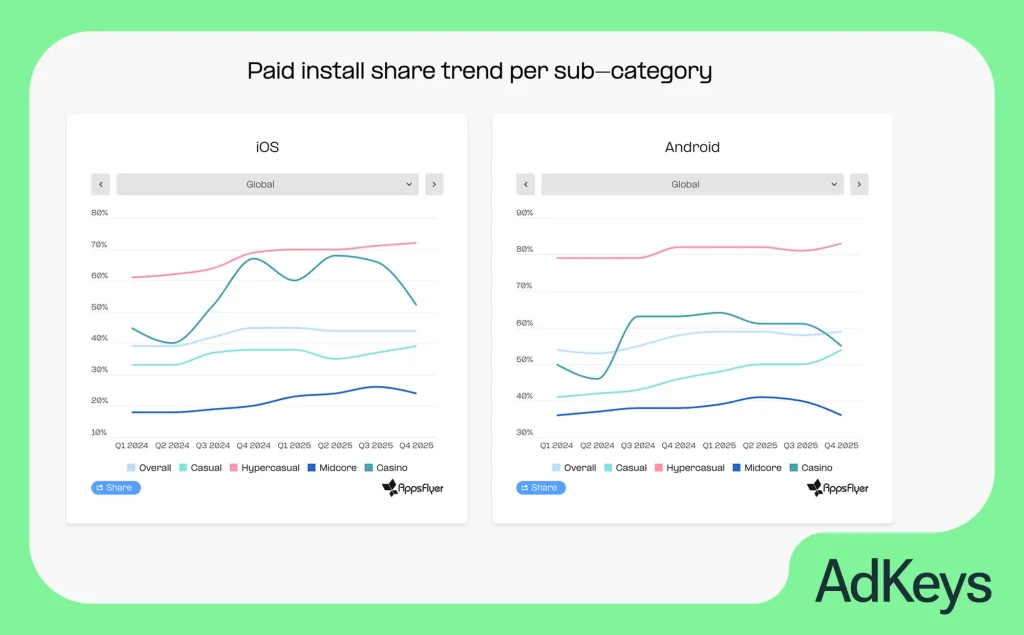
One of the report’s key findings is that the volume of advertising is growing faster than the player base.
In practice, this means that:
- Users are seeing more and more ads
- More and more studios are competing for the same players
- It’s becoming increasingly difficult to stand out in the market
As a result, CPI (cost per install) continues to rise in many countries. For mobile game publishers, this means that simply increasing advertising budgets is no longer an effective strategy. Marketing teams must focus on improving campaign efficiency, refining targeting, and optimizing creatives.
Artificial Intelligence is Transforming Mobile Game Marketing
Artificial intelligence has become one of the key drivers of change in mobile game marketing.
Today, top advertisers release 2,400-2,600 creative assets per quarter (25-30% more than a year ago), testing various versions of video ads, banners, and interactive ads.
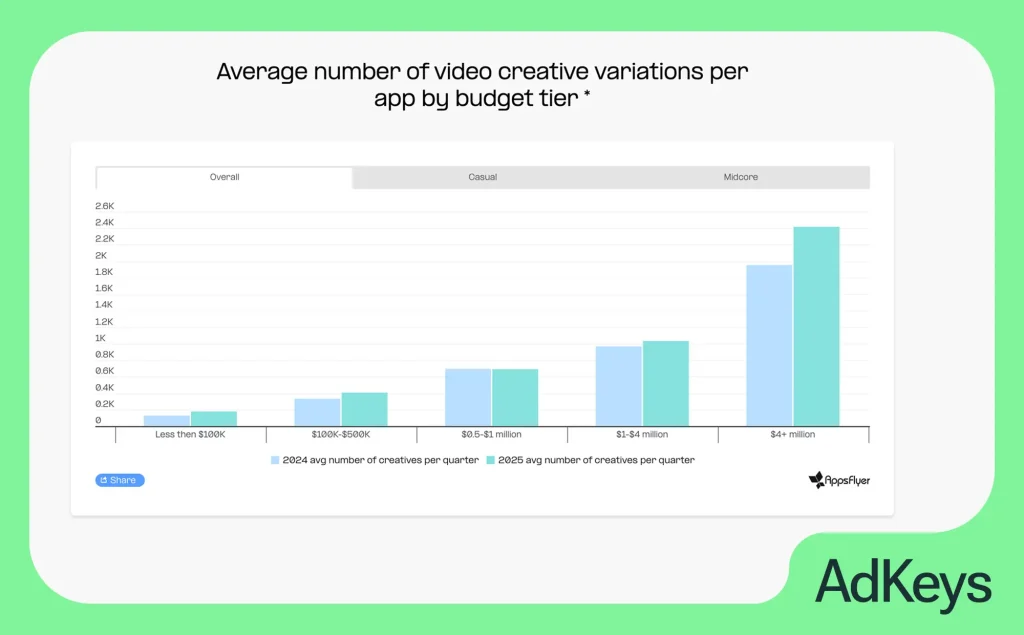
AI helps marketing teams:
- quickly generate a wide range of creative options
- automate video ad production
- analyze campaign performance
- process large volumes of marketing data
However, the paradox is that more creative content does not always translate to better performance. Consumer attention has not increased proportionally to the amount of advertising. This has led to “attention inflation”: the cost of each effective contact is rising, while the lifespan of a single creative is shrinking.
Today’s true competitive advantage lies in the ability to analyze data and make quick decisions.
Advertising Channels are Becoming Increasingly Fragmented
Another key trend highlighted in the report is the increasing fragmentation of marketing channels. Specifically, iOS marketers have increased the number of channels they use by 15% year-over-year.
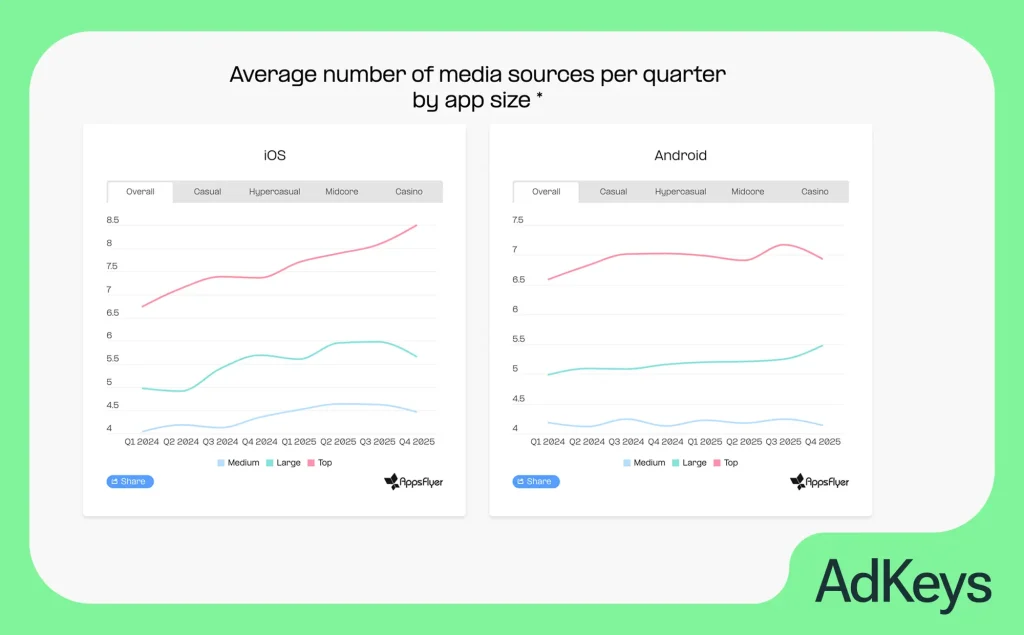
While many mobile games used to rely on a few major advertising platforms, today’s successful marketing strategies require a much broader media mix.
Modern UA strategies often include:
- social media advertising
- mobile ad networks
- rewarded video
- influencer marketing
- App Store optimization (ASO)
- web-to-app funnels
- cross-promotion within app ecosystems
Diversifying channels helps reduce reliance on a single traffic source and improves campaign scalability. However, for marketers, this means increased complexity in managing attribution and measuring channel effectiveness.
Emerging Markets are Becoming Drivers of Growth
Although mature markets, such as the United States, continue to generate the most revenue, growth is increasingly coming from emerging regions.
Among the fastest-growing markets are:
- India
- Turkey
- Brazil
- Indonesia
- Mexico
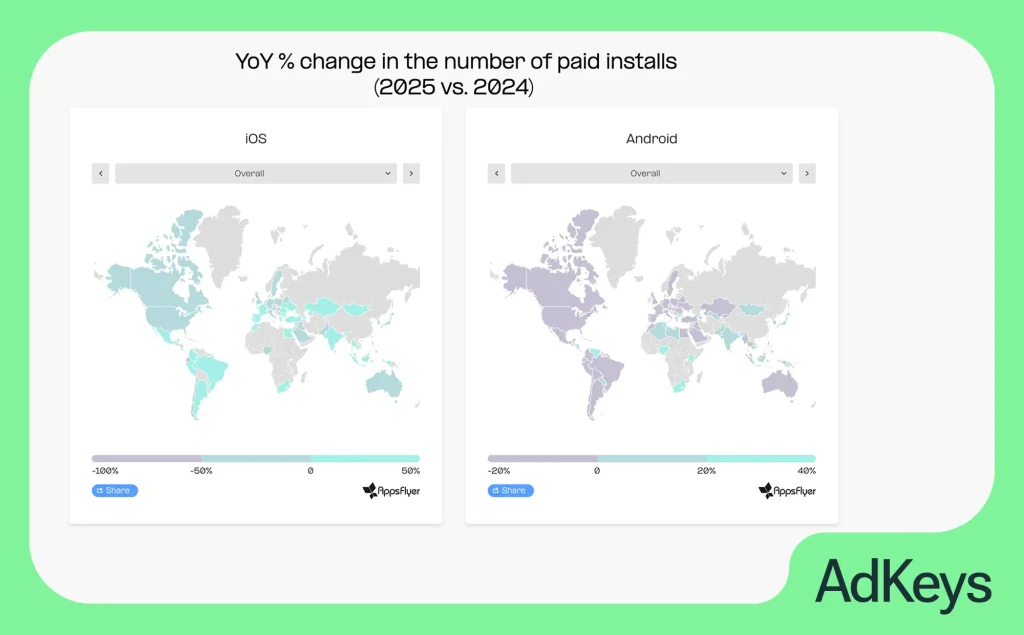
These markets offer a number of advantages:
- lower user acquisition costs
- rapid growth in smartphone penetration
- a young audience
- high engagement with mobile entertainment
For game publishers, entering these markets can significantly improve the economics of their advertising campaigns. However, success requires competent localization—adapting creatives, translating interfaces, and adjusting pricing models.
Chinese Publishers are Stepping Up Their Global Expansion
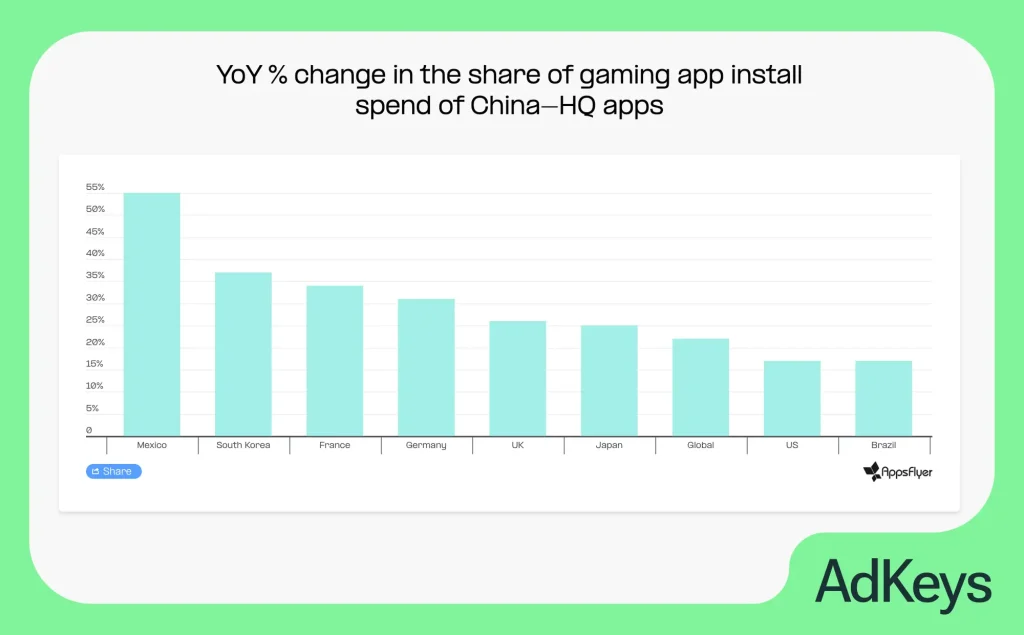
One of the most significant structural changes in the mobile gaming industry is the active expansion of Chinese developers into international markets. Chinese companies account for 35% of the total global user acquisition (UA) budget for promoting mobile games outside of China.
They are actively investing in major Western markets, including:
- the United States
- the UK
- Germany
- France
- Japan
Chinese studios are particularly strong in several areas:
- large marketing budgets
- advanced data analytics
- high production quality
- fast development cycles
Their aggressive marketing strategies are intensifying competition in global app stores. For other developers, this means that standing out in the market is only possible through a strong brand, unique gameplay, and a well-optimized marketing funnel.
Hybrid Monetization Is Becoming the Industry Standard
Another key finding of the report is the growing popularity of hybrid monetization models. Although the report’s primary focus is on marketing, a key finding pertains to monetization, specifically the growing popularity of hybrid monetization models.
Traditionally, mobile games have used one of two strategies:
- in-app purchases (IAP)
- in-app advertising (IAA)
However, more and more developers are beginning to combine these models.
Hybrid monetization allows developers to:
- generate revenue from non-paying users through advertising
- maximize revenue from paying players through purchases
- improve long-term return on marketing investment
According to the report, games with hybrid monetization often demonstrate significantly higher long-term ROAS than games using only a single revenue model.
Hybrid models (IAP + ads) show a higher return on ad spend:
- 146% ROAS by day 90 for mid-core games
- 93%—IAP only
- 58%—ads only.
iOS Restores Confidence
After several years of turbulence caused by privacy changes (ATT), iOS is once again the favorite. Budgets for iOS have grown by 6%, while those for Android have grown by only 2%.
The reason is that advertisers have adapted to SKAN 4.0 and have gained a better understanding of conversion modeling. As a result, confidence in ROAS on the Apple platform has stabilized.
Breakout Genres: AI Assistants and Short Dramas
The report highlights the emergence of new verticals that use game mechanics for monetization.
- Short Dramas: apps featuring vertical mini-series use progression systems and cliffhangers typical of mobile games.
- AI Assistants: This subgenre has demonstrated phenomenal monetization through subscriptions, taking time spent away from casual games.
The Main Challenge: Competing For the User's Attention
The main problem facing the market is an oversaturation of ads and content, which has led to a shortage of user attention. Players are exposed to thousands of ads every day across various platforms. As a result, it’s becoming increasingly difficult to capture their attention.
This leads to several marketing challenges:
- a shorter creative lifespan
- increasing demands on ad production
- faster audience “burnout”
To address this, successful studios establish continuous creative testing processes and rapid iteration cycles. Instead of a few expensive ad spots, marketing teams test dozens or even hundreds of ad variations.
Conclusions and Recommendations for Mobile Game Marketing in 2026

Based on an analysis of the AppsFlyer report, several strategies can be identified.
1. Building a Data-driven Marketing Strategy
Modern mobile game marketing is impossible without in-depth analytics.
Successful teams invest in:
- analytics platforms
- attribution systems
- BI dashboards
- predictive models
Data enables teams to identify the most profitable user segments and optimize campaigns more effectively.
2. Scaling Creative Testing
Since the market is oversaturated with ads, teams with fast testing cycles come out on top.
The approach that yields the best results is:
- creating a large number of creatives
- short testing cycles
- rapidly scaling the best ads
- disabling underperforming options
This model allows you to maintain campaign effectiveness even in highly competitive advertising environments.
And since AI simplifies the creation of creatives, the marketer’s role shifts from ordering assets to rigorously analyzing them.
Recommendation: invest in automated testing tools (Creative Intelligence). What matters isn’t how many variations you launch, but how quickly you pause the ineffective ones to avoid wasting your budget.
3. Diversifying User Acquisition Channels
Relying on a single advertising channel is becoming increasingly risky. Diversified user acquisition strategies reduce risks and stabilize CPI.
Typically, an effective media mix includes:
- social media advertising
- ad networks
- influencer partnerships
- ASO
- web acquisition funnels
Each channel plays its own role in the overall marketing system.
4. Expanding into Fast-Growing Markets
Declining performance in the U.S. is a signal to seek out new growth opportunities. Emerging markets offer significant opportunities for scaling mobile games.
Recommendation: consider Turkey and Southeast Asian countries. Acquisition costs there still allow you to test hypotheses with lower risk, and audience engagement is on the rise.
When entering new regions, it is important to consider:
- the level of competition
- average CPI
- payment infrastructure
- cultural characteristics of the audience
Proper localization can significantly improve campaign performance.
5. Optimizing the Entire Growth Funnel
User acquisition is just the first stage of a game’s growth. For sustainable growth, you need to optimize the entire user lifecycle:
- player onboarding
- retention mechanics
- monetization systems
- re-engagement campaigns
Games with high retention and strong monetization can afford a higher CPI and scale their marketing faster.
Conclusion
The AppsFlyer report shows that the mobile gaming market in 2026 will be a battle of algorithms and budgets. Success today depends on how effectively a company can work with fragmented data and manage vast amounts of AI-generated content, while maintaining a focus on return on ad spend (ROAS).
For developers and publishers looking to scale their games in the global market, investing in advanced analytics, creative testing, and international expansion are becoming key success factors.