In our recent article, “How to Overcome Banner Blindness: Trending Mobile Advertising Formats” we took a detailed look at how user perception is changing and why static creatives are losing their power. We discussed video, native advertising, and influencer marketing. But we deliberately left one format out of the discussion.
We are talking about Playable Ads—interactive or game-based advertising. We did not include it in the general selection because to call it simply “one of the trends” would be to greatly underestimate the potential of Playable.
Today, Playable Ads is the most effective tool in mobile app marketing. This format shows the highest ROI and attracts the highest quality audience. Therefore, it deserves not just a mention, but a separate analysis.
If you are a marketer, app owner, or e-commerce project owner, and you are still not using playable ads, this article is for you. In it, AdKeys team will discuss:
- what playable ads are and why they work better than other formats
- what businesses and apps they are suitable for
- market statistics
- practical tips and life hacks for creating and scaling playable ads.
What Are Playable Ads and How Do They Work?
Playable Ads is an interactive advertising format that allows users to interact with a product directly in the ad: play a mini-version of the game, test the app interface, or try out key service features.
The key feature of this format is the pre-installation experience. Users don’t watch videos or read descriptions; they literally “try” the product. That’s why this format consistently shows the best engagement, CTR, and traffic quality metrics.
It’s the “try before you buy” concept, transferred to the digital environment.
Why Are Playable Ads the King of Formats? Statistics and Facts
In 2025, playable ads dominated mobile advertising, especially in the gaming and e-commerce segments. According to Apptica, in 2025, the effectiveness of playable ads increased by 16% compared to 2024, reaching a record performance score of 191 (compared to 164 a year earlier). This indicator reflects their ability to stimulate installations and revenue growth. How does this happen:
1. Combating Banner Blindness
The modern user’s brain has learned to ignore static images and automatically scroll past videos. But interactive content triggers a different mechanism—curiosity and the desire to complete the action.
- Statistics: According to Liftoff’s “Ad Creative Index 2024” report, Playable Ads demonstrate the highest IPM (Installs Per Mille—number of installs per 1,000 impressions). It is almost 5 times higher than that of banners. This is direct proof that interactivity “breaks through” banner blindness: users don’t just see the ad, they get involved and convert.
2. Audience Filtering and LTV Growth
This is the main advantage for UA managers. Playable ads immediately filter out the non-target audience. If a person does not like the mechanics or interface, they simply will not install the app. Plus, the gap between expectations and reality is reduced, which means fewer disappointments and uninstalls.
- Statistics: Data from the ironSource platform confirms that users attracted through Playable Ads have a higher retention rate. The 7-day retention rate for such users is on average 30-40% higher than for those who came through a regular video. This means that you pay for a loyal user who will stay in the app for a long time.
3. eCPM Growth for Publishers
For those who monetize their apps with advertising, Playable Ads are a gold mine, as advertisers are willing to pay more for them.
- Statistics: The Appodeal Performance Index report notes that in Tier-1 countries (the US and Western Europe), Playable Ads consistently rank first in terms of eCPM on iOS, reaching $20-$35 and above. This makes them the most profitable format for publishers after Rewarded Video.
4. High Conversion Rate (CVR)
The Mintegral platform notes that Playable Ads account for 85% of all installs in hyper-casual games. But their share is also growing in the mid-core segment.
- Statistics: Mintegral’s research shows a shift in trends: while interactive ads used to be the preserve of simple “time killers,” Playable Ads now account for up to 70% of all installs in the Simulation genre and are showing explosive growth in Midcore/Hardcore strategies, where players are given a taste of the tactical part of the battle before downloading.
Important: Playable ads are almost always more expensive to produce, but they pay for themselves through the quality of the audience.
Playable Ads Are Not Just for Games
One common myth is that “this format is only suitable for toys.” But this has not been the case for a long time. In 2024-2025, there was explosive growth in interactivity in the non-gaming sector.
How Can It Be Applied in Other Niches?
E-commerce (clothing, cosmetics). Swipe mechanics (like in Tinder). “Choose your style: left or right?” At the end, the user is offered a selection of products based on their choice and a promo code. As a result, you get not just a click, but a user who has already viewed part of the catalog.
Food & Delivery. People love to play with food if it’s fun. Burger King’s famous gamification campaigns always show sky-high CTRs. Examples of mechanics: “Build a burger in 10 seconds,” falling ingredients that you have to catch.
Finance & Fintech (Banking). Gamification of complex financial products removes the barrier of fear of “boring numbers.” Mechanics used: quizzes or simulators. “Try to save up for a vacation by sorting coins” or “Calculate the benefits of cashback.”
Utility (Utilities, VPN, Cleaners). For example, visualization of phone cleaning. The user presses the “Boost” button, and the “junk” disappears from the screen. The feeling of satisfaction (ASMR effect) encourages the user to download the app.
Technical Side: How is it Created?
It is important to understand that playable ads are not just “excerpts from a product,” but separate advertising scenarios. Their creation can be divided into the following stages:
- Formulating the core value—what the user should understand in 15-30 seconds
- Prototyping the scenario (here, UX is more important than graphics)
- Developing the creative
- Testing (A/B)
- Scaling the best options
The creative is based on HTML5, which allows the ad to be lightweight, cross-platform, and run within the WebView of any application (Facebook, Unity Ads, AppLovin, ironSource).
The Anatomy of Perfect Playable Ads
Any high-quality interactive content is built according to a classic three-part structure. Violating this structure is a common reason for budget overruns.
- Lead-in (Training/Hook): a short video clip or animation (2-3 seconds) that explains what to do. The famous “pointing hand” appears, hinting at the mechanics.
- Gameplay (Interactive): the main part (10-20 seconds). The user interacts with the ad: solves a puzzle, controls a character, selects products. This is where the magic of engagement happens.
- End Card (Call to Action): final screen. The game ends (with victory or defeat), and a CTA (Call to Action) button appears—”Download”, “Get Bonus”, “Buy.”
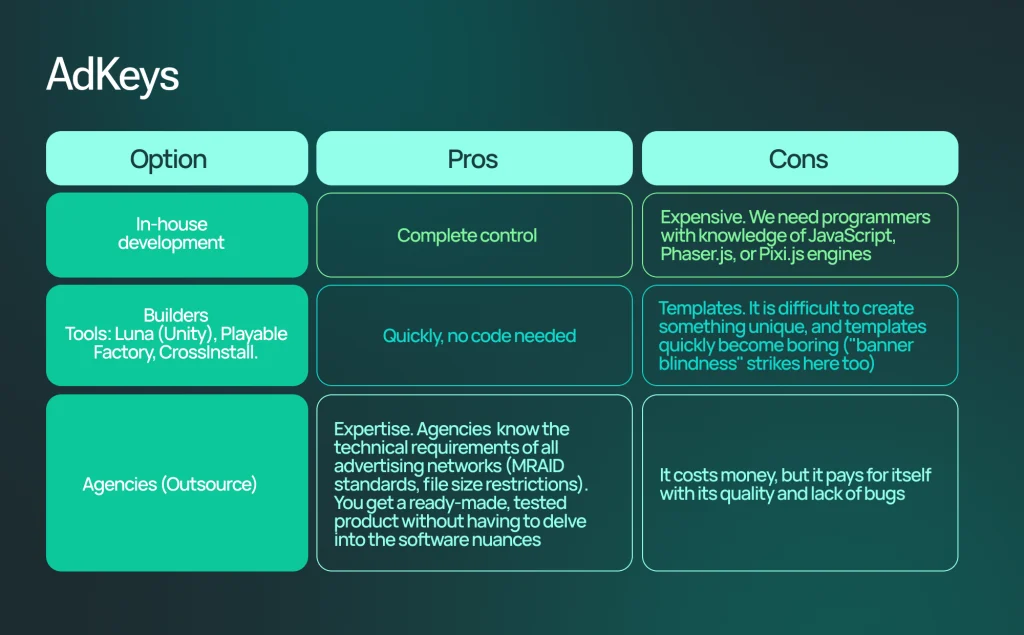
Ways to Create Playable Ads
Life Hacks and Best Practices: How Not to Blow Your Budget
We analyzed hundreds of campaigns and here are our insights:
- Keep it short. Keep it between 10 and 40 seconds. The first 2 seconds should grab attention.
- The 3-second rule (Onboarding). Users don’t have time to figure out complicated rules. If they don’t understand what to do within 3 seconds, they will close the ad. Use visual cues (dark background, pulsating hand). The text “Tap to play” is mandatory.
- Balance of complexity. Advertising should not be too easy (boring) or too difficult (disappointing). The ideal scenario is “Almost won.” The user should lose at the very end or win by a hair. The feeling of unfinished business is a powerful trigger to press “Try again.”
- Weight optimization. File size is a critical parameter. Advertising networks have strict restrictions (usually 2MB–5MB for the entire package). Optimize graphics. Use texture atlases. If an ad takes longer than 2 seconds to load on 4G, you’ve lost 50% of your traffic.
- Adaptability. Your Playable should look perfect on both vertical screens (TikTok, Instagram) and horizontal screens (games). Mistakes such as stretched assets or buttons that extend beyond the edge of the screen undermine trust in the brand.
- Honesty in gameplay. A few years ago, “fake” ads were popular (where you rescued a princess, but the game was actually “three in a row”). Now, stores and ad networks ban such ads. Gameplay in advertising should reflect the essence of the real app. Otherwise, you will get cheap clicks but zero retention.
- Many tests. Create 5-10 options (themes, mechanics), conduct A/B tests, scale the best combinations.
Performance Metrics: What to Look For?
Playable ads are a format that cannot be evaluated using a single metric. A high CTR alone does not guarantee success, and an expensive CPI does not always mean a bad campaign. Below are the key metrics to look at and how to interpret them correctly.
1. ER (Engagement Rate)
The percentage of users who started interacting with playable ads. It shows how clear the scenario is, whether the mechanics are engaging, and whether the first screen is implemented correctly.
How to interpret:
- low ER → the user does not understand what to do (poor onboarding);
- high ER → good first screen, understandable UX.
2. Completion Rate
How many people played to the end? If the number is low, the game is too long or too difficult. Reduce the time to 15-20 seconds.
3. CTR (Click-Through Rate)
CTR for playable ads is almost always higher than for video ads, but it is important to look at the dynamics.
How to interpret:
- high CTR + poor post-install metrics → misleading scenario;
- average CTR + good retention → high-quality traffic.
Tip: don’t chase record CTR if it worsens LTV.
4. Install Rate (CVR per install)
Shows how many users actually install the app after interacting with playable ads.
If CVR is low:
- playable is too complicated
- the user “got everything for free”
- the creative does not match the actual product
- weak call-to-action.
5. CPI (Cost Per Install)
One of the most popular metrics, but also the one most often misinterpreted.
Important:
- playable ads may have a higher CPI at the start
- CPI should be evaluated together with retention and LTV.
The right approach is better CPI +20%, but Retention Day 7 +30%, than cheap but empty traffic.
6. Retention (Day 1 / Day 7 / Day 30)
A key metric for evaluating the quality of playable ads.
What to look for:
- Does retention meet expectations for the channel?
- Is there a sharp drop after Day 1?
If retention is high, it means that the creative correctly conveys the core mechanics and user expectations match reality.
7. LTV и ROAS
Playable ads perform particularly well when the focus is on long-term LTV and in campaigns optimized for events. But don’t expect results in the first few days—this format reveals its potential over time.
Playable Ads Trends 2026: Where Are We Headed?
The playable ads market is developing rapidly. While just a few years ago it was an experimental tool in gaming, today it is a full-fledged performance channel, and in 2026 its role will become even more significant.
Below are the key trends that are already taking shape and will determine the effectiveness of playable ads in the coming year.
Hybrid Formats
One of the most notable trends is hybrid creatives, where classic video seamlessly transitions into interactive content. How it works: the first 5-10 seconds feature a dynamic video with an emotional hook, then a “Try it” CTA appears and the user is immediately taken to a playable scenario.
The video’s job in this tandem is to quickly grab attention, while the interactive element is responsible for engagement.
Who it’s especially relevant for:
- non-gaming apps
- products with value that isn’t obvious to the user
- brands that need to explain the context first.
Using AI
AI is already actively used to generate graphic assets and backgrounds, adapt UI to different placements, quickly create variations of a single scenario, perform automatic localization, and other tasks. It is expected that by 2026, AI will become a standard tool for producing playable ads.
The use of AI reduces the cost and time required to produce creatives and allows for more A/B testing without increasing the budget.
It is important to understand that AI does not replace strategy and UX, but teams that know how to use it correctly gain a significant advantage.
Playable on CTV (Connected TV)
Interactivity goes beyond mobile screens. Playable ads are developing on CTV – Smart TV, Android TV, Apple TV.
How it works:
- ads are shown on a large screen
- control is via remote control
- scenarios are adapted for simple actions (left/right/ok).
High attention levels, minimal competition for inventory, and a strong wow effect—the advantages of this format are very appealing.
However, this type of advertising requires simpler creatives and is aimed more at attracting attention and brand recognition than at direct installs.
Deep personalization
Personalization goes beyond simple text substitution. Changing the complexity of playable ads, different characters and visual styles, adapting the script to the traffic source or user segment—all of this is already available.
Even with limited access to IDFA and GAID, contextual signals, placement data, display time, and behavioral patterns within the playable itself are used.
The result:
- higher engagement rate
- better retention
- less user frustration.
Conclusion: Is It Worth the Effort?
Playable Ads are not just a cool “toy.” They are a complex, high-tech tool that, when used correctly, reduces the cost of user acquisition and improves its quality.
Yes, producing a Playable Ad is more expensive than cutting a video. Yes, the technical requirements are more stringent. But when you see user LTV grow by 30%, there are no more questions.
If you want to incorporate Playable Ads into your strategy but don’t know where to start, or are afraid of wasting your budget on a technically weak implementation, the AdKeys team is here to help. We know how to turn users into players and players into loyal customers.
Don’t let your users get bored. Let them play!